What your guests cannot find out before they book
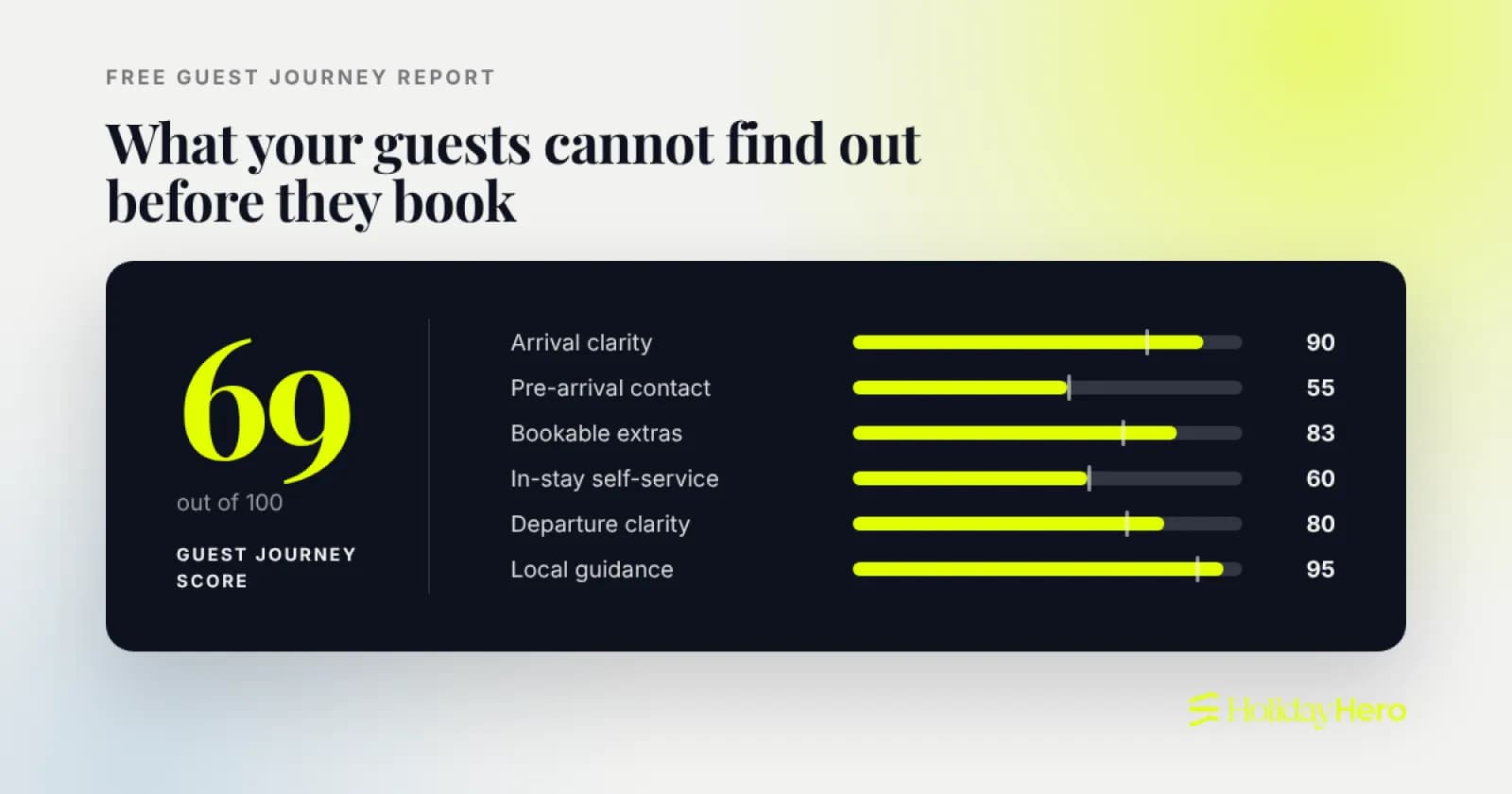
100+ properties analysed / 24 checks in every report / Free full analysis, including the fixes
"Very interesting report which allow me to execute some quick fixes. I've known about some of these inconsistencies, but now I know where they are exactly and how to fix them"
- Front Office Manager, boutique hotel, 56 rooms
We have spent years building and running guest journeys for hundreds of properties.
A guest journey is a series of interactions between a guest and you, as a hotel and as a brand. A large part of those interactions is simply information moving, and it moves in two directions. Push, where you send something proactively: the confirmation, the mail before arrival, the message on the morning of checkout. And pull, where you make something available to be found or asked for: your website, your listing, your FAQ, the person at the desk.
Before a booking exists, push is almost impossible. You have no reservation, no address and no permission. Everything rests on pull, which makes it the one stretch of the journey where clarity is the only tool you have. It is also the only stretch you cannot see afterwards: no reservation, no messages, no file, no feedback. Just a person on your website or your Booking listing, looking for an answer and finding it, or not.
This report shows you that stretch. Free, for your property, within three working days.
Why this is free
Because we make the platform hotels use to manage their guest communication and all the information that goes with it, from before booking through to after checkout, and we would rather show you we understand your property than tell you.
That is the whole catch. The three fixes in your report are things you can do yourself, in your own extranet, without buying anything. Plenty of people will read it, fix two things and never speak to us again. That is a fine outcome.
What you get
A score out of 100, with all 24 checks and the ten-item extras inventory printed so you can see exactly how it was built, check by check, with the evidence next to each one. If you disagree with a score, you can see precisely where it came from.
The questions your guests cannot answer, ranked by how often they actually raise them, quoted from your own reviews with the date and the score that guest gave, so you can find every one back in your extranet in under a minute.
What it costs you in time, estimated, with the arithmetic written out in words: your rooms, your occupancy, which checks are open and how often we assume a guest asks. A number you can argue with beats a number that appears from nowhere.
Three fixes, specific to your property, written the way you would hand work to a colleague: the facts to write down, one worked example in your own vocabulary, and which screen in the extranet to paste them into.
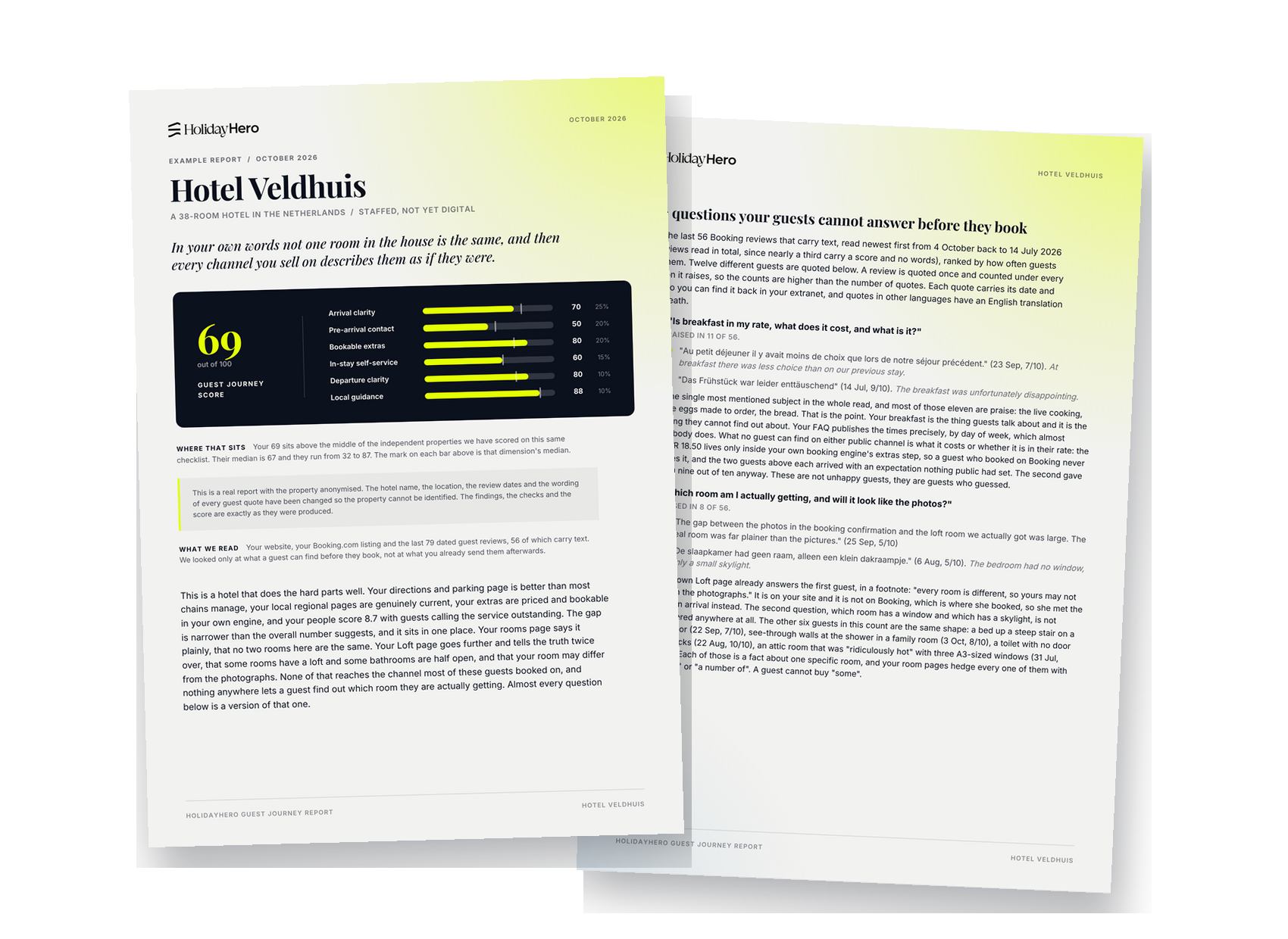 A real report, anonymised. This one scores 69, a little above the median. Its first finding is a hotel whose own rooms page already answers the question its guests keep asking, on a page those guests never see.
How it works
- You give us one link. Your website. We find your Booking listing ourselves.
- We read your property the way a guest does, then score it. A person checks every report before it goes out.
- It arrives by email as a PDF, within three working days and sooner if we can.
We never contact your team, we never mystery shop you, and we only look at what is publicly visible. Which means we may point at something you already answer in your confirmation email. If we do, tell us, because that gap between what you send and what a guest can find is worth knowing about too.
Why you could not just do this yourself
The public information is where we start, not where we finish. What we look for, and how heavily each check counts, comes out of years of running guest journeys for hundreds of properties: which questions guests actually ask, at which moment they ask them, and which ones quietly cost a booking rather than a message.
That part is not on anyone's website. It is the difference between a list of things your site does not mention, which you could write yourself in an afternoon, and a ranked, weighted picture of which of them are costing you something.
We have now analysed more than a hundred properties this way, and your score is set against the ones scored on this exact checklist. Your report says where you sit in the range, and puts the benchmark median next to your own score on each of the six dimensions, so the comparison is on the page rather than in a claim.
What we usually find
Across the properties in the benchmark, the two weakest stretches of the journey are the same everywhere: what happens between the booking and the arrival, and what a guest can sort out for themselves once they are in the building. Both average 59 out of 100, while local recommendations average 76. Independent hotels are good at telling you what to do in the city and quiet about everything that touches their own front door.
What shows up almost every time:
- At least two facts that contradict each other between a property's own site and its Booking listing. Check-in times, parking, checkout, pets, breakfast. Every property so far.
- Everything you sell, hidden inside your own booking engine. On most of the properties we scored, the breakfast price, the late checkout fee and the parking rate exist only on the extras step of the direct engine. An OTA-booked guest cannot see any of them, and neither can anyone comparing you before they book.
- Guests doing the briefing for each other. At one rural hotel, three guests who gave ten out of ten used their reviews to warn the next guest about the road, the wait for a taxi and bringing a car small enough to turn in the car park. None of that was on the hotel's site.
- A room fact that only exists in reviews. At one city property, seven of the last fifty written reviews mention that the windows do not open. The website says "climate control".
- Money left on the table quietly. One hotel's own booking engine could not sell a single night of the coming season, while the OTA was selling it the whole time.
Who this is for
Independent hotels, hostels, aparthotels, B&Bs and holiday parks, from roughly five units upwards. Most of the properties we work with are in Europe, and the report works anywhere in the world. Ask wherever you are.
Questions people ask first
Is it really free, and is there a call attached? Free, and no. You get the report by email. If you want to talk afterwards there is a link in it, and if you do not, nothing happens.
What do you need from me? Your hotel website address, obviously. And your name and email, so we can send it to you.
How long does it take? Three working days, usually less.
What if I disagree with something in it? Tell us. Every check is printed with its evidence, so disagreements are specific and quick to settle. We would rather be corrected than polite.
Do you store my guest reviews? We keep the review text, date and score so we can show you where a finding came from and compare a later report against this one. We do not store reviewer names.
One link, three working days
We will read your property the way your next guest does, and tell you what they cannot find.