Guest registration requirements in Europe, by country
A country-by-country table of guest registration requirements in six European markets, with the official authority source and the date it was last checked. Only three of the six have a filing system at all; in the other three the duty is to hold a register at the property and produce it on request.


It is 22:00, an authority has been in touch, and somebody is asking which register you keep. What you want is a table, not an essay. So here is one: six markets, official sources, dated.
With the correction that surprises most operators: guest registration requirements in Europe are not all filings. In three of these six there is nothing to submit, and the duty is to hold a record at the property and produce it on request. This page sits in the Frictionless Arrival pillar, next to last week's entry on passport scanning check-in software.
What does every European country actually ask for?
The common core is four things: a name, the arrival date, the departure date or length of stay, and a link to an identity document or a place of residence. Then the lists separate. The Dutch one is shortest and asks the document type, not its number (art. 438 Sr). The German one is fixed at eight items (§ 30 BMG). The French one alone asks for a mobile number and email (service-public.gouv.fr). And Anexo I of Real Decreto 933/2021 asks Spanish operators for a payment block, card number included (BOE). That is what the decree says, and we will not soften it.
Guest registration and ID verification for vacation rentals in Europe, country by country
Read the third column first. It decides how much work a property has.
| Country | What is required | Authority system | Who it covers | Filing window | Official source | Last checked |
|---|---|---|---|---|---|---|
| Netherlands | nachtregister, a continuous register kept per guest (art. 438 Sr) | No filing system. Held at the property, shown to the burgemeester on request. Some municipalities run a Digitaal Nachtregister | All guests. Accompanying spouses, minor children and travel groups exempt | None. Entered immediately on arrival | art. 438 Sr | 28 Sep 2026 |
| Spain | Partes de entrada, plus registro documental and comunicación of traveller, contract and payment data (RD 933/2021) | SES Hospedajes, Ministerio del Interior, telematic | All guests, professional operators and not; signature from 14 | Immediately, and in any case within 24 hours of the reservation and of the start of services | interior.gob.es | 28 Sep 2026 |
| Italy, police filing | Identities of those accommodated, one schedina per guest (art. 109 T.U.L.P.S.) | Alloggiati Web, Polizia di Stato, to the competent Questura. Electronic only | All guests, every kind of accommodation, plus lettings under 30 days | Within 24 hours of arrival, 6 hours for stays not over 24 hours. Separately, a Capo della Polizia circular of 18 November 2024, upheld by the Consiglio di Stato in October 2025, requires the manager to verify the guest de visu: remote-only check-in does not satisfy that duty | alloggiatiweb.poliziadistato.it | 28 Sep 2026 |
| Italy, statistical reporting | Monthly arrivals and overnight stays for the ISTAT survey, nil months included | Ross1000, run by each Region for its own territory, feeding ISTAT. Not the police | Operators in the region. Response is compulsory | Set regionally. Lombardy, by the 5th of the following month; Emilia-Romagna, within 30 days of month end | Regione Lombardia, Emilia-Romagna | 28 Sep 2026 |
| Portugal | boletim de alojamento per guest, on entry and again on exit (arts. 15-16 Lei 23/2007) | SIBA, run by the SSI, Unidade de Coordenação de Fronteiras e Estrangeiros | Foreign guests only: every non-Portuguese guest, any age, every member of a group | Three working days, for the arrival and again the departure | siba.ssi.gov.pt | 28 Sep 2026 |
| France | fiche individuelle de police per guest, including mobile and email (CESEDA R814-1 to R814-3) | No filing system and no portal. Kept at the property six months, handed over on request | Foreign guests only, including EU citizens. Under-15s may go on an adult's fiche | None. Nothing is filed | service-public.gouv.fr | 28 Sep 2026 |
| Germany | besonderer Meldeschein per guest, an exhaustive list of eight items (§ 30 BMG) | No filing system and no portal. Held at the property; data collected electronically under § 29 Abs. 5 BMG supplied machine-readable | Foreign guests only since 1 January 2025. Accompanying foreign spouses, partners and minor children by number only | None. Signed by hand or confirmed electronically on the day of arrival. Kept one year from departure, then destroyed | § 29, § 30 BMG, BeherbMeldV | 28 Sep 2026 |
Six markets, not a continent. There is no EU-wide register, and the set of countries we file to is expanding rather than finished.
Only three of these six file anything
Spain, Italy and Portugal file to an authority system on a deadline. The Netherlands, France and Germany do not file at all: the nachtregister is shown to the burgemeester on request, the fiche goes to police or gendarmerie only on their request (CNIL), and Meldescheine are produced to the authorities entitled to ask for them.
So any sentence treating all six as filings is wrong. A record that exists, is complete on arrival and can be produced is a different job from an API call.
All guests, or foreign guests only?
Scope differs at the root. Spain and Italy cover all guests. Portugal, France and Germany cover foreign guests only. The Netherlands covers all guests, with the exemption above.
Germany is the freshest. The Viertes Bürokratieentlastungsgesetz of 23 October 2024 inserted the word "ausländische" into § 29 Absatz 2 Satz 1 BMG with effect from 1 January 2025, so the duty now covers accommodated foreign guests rather than all guests (BGBl. 2024 I Nr. 323). Germany did not abolish the Meldeschein. It narrowed who is on it. Portugal's SIBA covers non-Portuguese guests under art. 45 of the Schengen implementing convention (SIBA). Foreign-guests-only is not simpler: it puts a condition in the register, evaluated per person.
Italy runs two systems, not one
Alloggiati Web is the police filing, to the competent Questura under art. 109 T.U.L.P.S., one schedina per person, within 24 hours of arrival. Ross1000 is statistical reporting, to the Region and on to ISTAT under D.Lgs. 322/1989, as monthly arrivals and overnight stays.
They are not alternatives and not two stages of one process. Both apply to the same property: Veneto tells operators to record guest data in Ross1000, then upload a file from it to Alloggiati Web separately (Regione Veneto). One arrival, two filings, two authorities, two clocks. The statistical deadline is regional, so two regions means two calendars.
Italy also asks for the guest to be seen
The most useful thing we can tell an Italian operator is not about our software.
On 18 November 2024 the Capo della Polizia issued circular prot. n. 38138 to all Prefetti and Questori: the art. 109 T.U.L.P.S. duty on managers of every kind of accommodation includes verifying de visu that the people accommodated correspond to the documents produced, and remote check-in procedures were excluded. The TAR Lazio annulled it; the Consiglio di Stato, Sezione Terza, allowed the Ministry's appeal on 9 October 2025 and dismissed the challenge in full (ricorso n. 5732/2025).
So the circular stands. A check-in completed entirely remotely does not satisfy the Italian police identification duty, and no software changes that, ours included. The Questura di Agrigento restated the same duty in December 2024 (Questura di Agrigento).
We will not interpret that judgment and we will not sell you a way round it. Sending a schedina on time is one duty. Verifying the guest is another, and not a data problem.
Why a digital registration card for a hotel did not remove the work
The booking got digitised. The register did not.
The reservation arrives electronically. Then a person opens a second window, retypes a subset of what the property already holds, adds the fields the authority wants and the booking never carried, and submits it. A digital registration card for a hotel digitises the paper without removing the retyping, because the fields still start empty. And a 24 hour clock from arrival does not care which PMS holds the booking. The systems keep moving: Spain's register carries three official dates, the latest the Ministry's activation announcement of 2 December 2024 (press release).
Automatic guest registration to the police, as a by-product rather than a product
Registration should be a by-product of a check-in the guest actually wanted to finish. The argument is structural, not comparative.
A compliance tool asks a guest to complete a form that gives them nothing back. So a predictable share abandon it, staff chase the rest, and the work lands at the desk on arrival. The form was digital. The job was not automated.
Put the same fields inside a check-in that returns something the guest wants, and the register fills itself from what the guest entered. Where the country has a system to file to, the filing goes from that record: today SES Hospedajes in Spain and Ross1000 for Italian regional statistical reporting.
Camera ID capture reads a document and fills fields. That is the whole claim. It does not verify identity and it does not detect fraud. It removes the typing, not the judgement, which is why the Italian position above is a constraint, not a gap a scanner closes.
What the guest sees
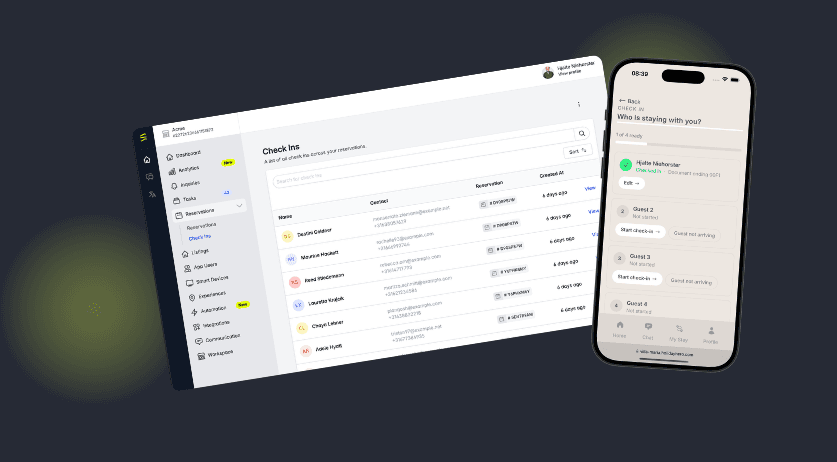
Nothing about registration, ideally. They tap a link in a message on the channel they already use, confirm who is coming, scan a passport with the camera, sign with a finger, and get back the code, the time and the directions. The register was written while they did it, in the same arrival flow as last week's entry. No clipboard, no photocopier, no portal tab, nobody typing a date of birth off a card.
Who owns the guest data after the stay, you or the OTA?
Compliance is why an operator starts. Ownership is why they stay.
A guest who books through an OTA arrives as a masked address and a first name. You can serve the stay, but you cannot write to them next spring, and when the platform changes what it passes through, your list changes too. That data is rented.
A guest who completes your check-in leaves you the record: names, contact details, language, document details, what they signed and when. It sits on the reservation in the PMS you already bought, which stays the system of record while we write the enriched record back, under GDPR with EU data residency.
What to check before you automate
Does it file at all? Where the table says no filing system, a portal integration is not what you need. Where it does, credentials come from the authority, not the software: your Questura for Alloggiati Web, UCFE for SIBA.
Regional or municipal variation? In Italy the statistical platform and deadline are regional. In the Netherlands the duty is national but the digital register is municipal, Gemeente Waadhoeke being one example (waadhoeke.nl). In Germany, § 30 Abs. 3 BMG lets a Land add fields for tourism levies.
How long is the record kept? Spain, three years from the end of the contracted service. France, six months. Germany, one year from departure, then destruction within three months. Italy requires transmission receipts kept five years digitally, a duty on the receipts and not the guest data.
Can it be held electronically? Germany answers that expressly, down to the XML file naming. France does not.
Who signs it off? Somebody at your property reads the authority page in the table and confirms what applies to you. Not us, and not any vendor.
The software question is the small one. The flow sits on the PMS you already run (Mews, and the directory), from €6.50 per unit per month, or book a demo.
This page describes what the authority systems we file to ask for, as they stood on the date shown. It is not legal advice. Every operator stays responsible for confirming their own obligations with the authority named here.
Frequently asked questions
Is online check-in legally valid for hotels in Europe?+
What information do I have to collect at hotel check-in?+
How do I file the guest register if my PMS does not support it?+
Keep reading