You get paid at the booking. You earn it during the stay.
Google is turning the hotel booking into a standard that any AI can complete. But the protocol stops at "completed", and the reviews that decide your next booking are written during the stay.

You get paid at the booking. You get ranked by the reviews. You earn both during the stay.
That's the loop every hotel, holiday park, hostel and rental lives inside. And yet almost all the software our industry has bought over the past twenty years sits on the first step of it.
Google has just made that imbalance more visible than ever.
Software has always followed the money
Look at a typical hospitality tech stack. A PMS. A channel manager. A booking engine. Revenue management. A rate shopper. Metasearch campaigns. Each one answers a version of the same question: when, where and at what price does this room get sold?
That makes sense. The booking is where money appears, so that's where software vendors built and where operators spent.
The stay itself, the part the guest actually came for, has often been run on whatever was left: a PDF welcome letter, a WhatsApp from someone's personal phone, a front desk that closes at 23:00, and a lot of goodwill from the team.
Google just turned the booking into a standard
In May, Google said its Universal Commerce Protocol (UCP), the system that lets AI complete purchases inside Google's search and chat interfaces, would expand to hotel booking. On 27 August, hotel booking started rolling out in AI Mode for US English users, with ten hotel chains and travel platforms as launch partners. On 25 September, the first draft of the UCP Lodging Booking specification was published on GitHub, and Google says it will adopt it for hotel booking in AI Mode over the coming months. For everyone outside the launch partners, onboarding is still a waitlist.
The draft spec is worth reading, because of what it standardises:
- The property, which explicitly includes hotels, resorts, villa estates and cabin parks.
- The accommodation, from a room to an apartment, a villa or a campsite pitch.
- The rate plan, occupancy, guests and dates, in fixed fields.
- The full price, including taxes and fees collected at the property, which must be shown before the guest confirms.
- The payment schedule: pay now, a deposit with the balance later, or pay at the property.
In other words, the booking is becoming a structured, interchangeable transaction that any AI platform can run against any property that speaks the protocol. Good news for operators: you stay the merchant of record, and your terms apply. But it also means the booking step is becoming less and less where you stand out.
Where the protocol stops
The spec has a status for the end of the journey: completed. Once a booking reaches it, the booking is immutable, and the business is required to send a confirmation email. That's where the protocol's job ends.
There is nothing in it about the arrival. Nothing about the door code, the parking, the late check-in, the Wi-Fi, the extra night or the question a guest sends at 23:00. That isn't a flaw in the spec. It's simply not what a booking protocol is for.
Even the booking itself stays human for now: unless an extension for agent-led payments is used, the AI hands the guest over to a confirmation screen, and the guest presses "Book".
So AI can now sell your room. It won't welcome your guest.
The algorithm reads reviews. Guests write them about the stay.
Here's the part of the loop that connects everything.
Google's own guidance on local ranking is explicit: the number of reviews and your review score factor into how prominently a business ranks. In AI Mode, guest reviews are shown alongside the hotel options before the traveller books. And Google states that integrating with UCP does not change how your property or rates are ranked. The booking integration gets you a button. It doesn't get you a position.
What moves the position is what guests say about you. And nobody reviews your rate plan or your channel manager. They review:
- whether the arrival instructions came on time,
- whether they could get in at 1am,
- whether anyone answered when the shower didn't work,
- whether the place felt prepared for them.
The cycle
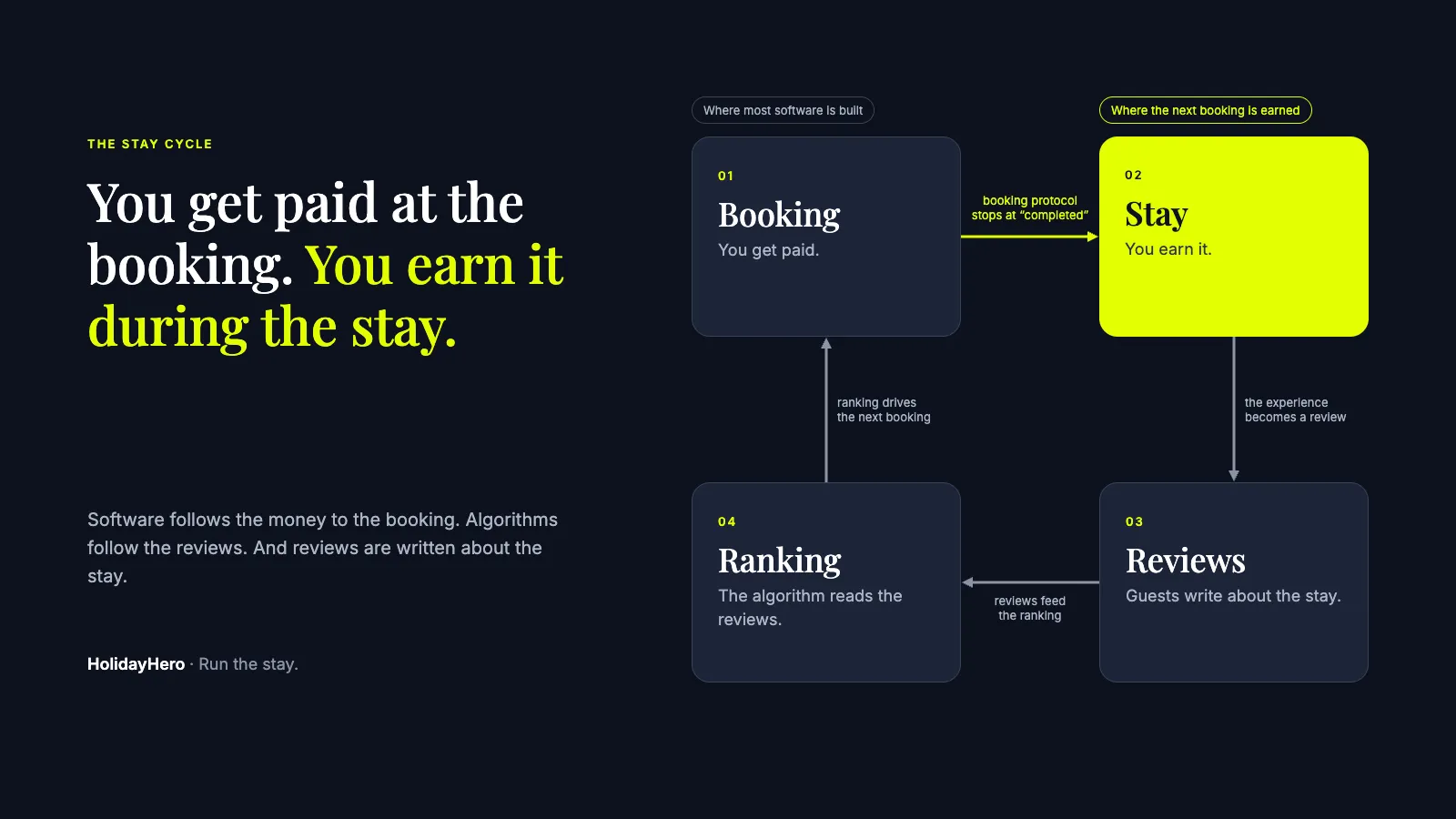
Put it together and you get a loop:
- The stay creates the experience.
- The experience becomes a review.
- Reviews feed the ranking, and the decision, whether a person or an AI is comparing options.
- The ranking drives the next booking.
- The booking pays the bill, and hands a new guest over to the stay.
Most tech stacks are strong on steps 4 and 5 and thin on steps 1 and 2. That's a problem, because the loop compounds in both directions. One messy arrival doesn't cost you one guest. It costs you a review that sits next to your book button for months, for every human and every AI that looks.
It's worth keeping perspective on timing. Booking Holdings reported that bookings coming through AI agents are still under 1% of its room-nights. The AI channel is small today. But the loop isn't new: it already runs through every OTA listing and every Google search. AI just makes the booking step faster, which makes the stay matter more.
What owning the stay looks like
If the booking is becoming a commodity, the stay is where the work pays off. In practice, that means:
Arrival information before the guest asks. Online check-in and a digital guidebook, sent from the moment of booking, through a channel that always reaches the guest.
Access that doesn't depend on someone being there. Door codes or mobile keys released once check-in is complete, not texted to whatever number came in with the reservation.
Answers at 23:00. Guests ask the same questions at the worst times. An inbox that answers instantly, in your voice and your guest's language, is the difference between a small hiccup and a two-star review.
Offers that fit the stay. Late check-out, an extra night, breakfast, a bike: offered at the moment they're useful, they're part of a better stay, not a sales pitch.
Fix it while the guest is still there. A problem raised during the stay can still be solved. A problem discovered in a review cannot.
How this works in HolidayHero
This is the part of the cycle HolidayHero is built for. Every reservation, from any channel, gets an online check-in and a guest portal with everything the guest needs to arrive: guidebook, house rules, access through connected smart locks, and offers for their stay. During the stay, the conversation runs in one AI inbox that answers in the property's own voice, around the clock, and hands over to your team when it should.
It doesn't matter whether the booking came from a website, an OTA or an AI assistant. The stay is the same, and it's yours.
Audit your cycle
- Which of your tools work on the booking, and which on the stay? Draw the line honestly.
- What does a guest receive between booking and arrival, and does it depend on a phone number or a person?
- Can a guest get in at 1am without anyone picking up the phone?
- How long does a question sent at 23:00 wait for an answer?
- What are the three most common complaints in your recent reviews? Which step of the stay do they come from?
- If an AI summarised your reviews tomorrow, what would it say about arriving at your property?
The next booking starts now
Google, the OTAs and every AI assistant will keep making it easier to sell a room. That's welcome. But they all decide who to show first by reading what your last guests wrote, and those guests were writing about the stay.
You get paid at the booking. You earn it during the stay.
Run the stay.
Sources: Google UCP for Lodging FAQ, UCP Lodging Booking draft specification, Search Engine Journal on the draft spec, Google Business Profile: how to improve your local ranking, Travel Daily News on hotel booking in AI Mode, Hospitality-On on Booking Holdings' agentic share.
Frequently asked questions
What is UCP for Lodging?+
Can holiday parks and vacation rentals use UCP?+
Does integrating with UCP improve my ranking on Google?+
Who looks after the guest after an AI booking?+
Hjalte is CEO and co-founder of HolidayHero, an Amsterdam-based platform that runs the whole guest stay for hotels, holiday parks, hostels, aparthotels and short-term rentals. He also runs a rental property himself, which is a decent cure for building features nobody asked for. Most of his writing here is product: new integrations, guest registration and compliance work, and the reasoning behind decisions that show up in your account a few weeks later.
Keep reading